What Power Can’t Win
Why military superiority cannot defeat Palestinian nationalism
[3,350 words—a 14-minute read.]
PS: Since this is a long post, keep in mind these words from Substack: If the newsletter is truncated in an email, readers can click on "View entire message," and they'll be able to view the entire post in their email app.]
Israel’s advantages over the Palestinians of Gaza and the West Bank are overwhelming: a world-class army, a technologically advanced economy, control of both territories’ borders, water, and airspace, and decades of near-unqualified American diplomatic cover and copious economic and military assistance. These sources of power led Defense Minister Israel Katz and Finance Minister Bezalel Smotrich to openly support building settlements in Gaza and to allude to annexing parts of it. Israel has also been annexing the West Bank in all but name.
What Israel has not achieved, and cannot achieve despite these advantages, is lasting security; instead, it will experience recurring cycles of resistance, even violence. Two centuries of occupations do not offer many examples of a determined national movement being subjugated purely by force. Israel’s leaders are betting that they can defy the odds, despite their country’s increasing isolation and even the unprecedented loss of support in the United States. In a recent Gallup poll, 41% of Americans sympathized more with the Palestinians, and 36% more with the Israelis—this after a quarter-century during which Israelis consistently led by double digits. Calls for ending American economic and military support, till recently a fringe idea, are now common. What’s more, 57% of Americans back the idea of creating a Palestinian state—which Prime Minister Benjamin Netanyahu and others in his cabinet have vowed to prevent—and 41% (including 67% of Democrats) believe that Israel’s war in Gaza qualifies as or comes close to genocide.
Gaza: The Ceasefire that Isn’t
The Trump-created Board of Peace and the hype about plans to rebuild Gaza have been exposed for the drivel they were from the get-go. Here’s the reality: Israel now occupies close to 70% of Gaza, compared to 53% when the October 2025 “ceasefire” was signed. Gaza’s two million people have been shoehorned into the remaining one-third of their homeland. About 80% of Gaza’s buildings and 92% of its homes have been damaged or destroyed, leaving a hellscape of 60 million tons of rubble—more, by some estimates. It could take seven years or more to clear the debris. But this recent estimate from the UN Development Program assumes ideal conditions—safety and unrestricted access, and $110 million in funding—which are nowhere on the horizon.
This month the Board of Peace abandoned its ambitious reconstruction plan for Gaza and scaled it back to what the Guardian called “a small pilot project in the south of the strip” amounting to “a temporary camp for a tiny fraction of Gaza’s 2 million displaced people.” This pared-down plan is the equivalent of a gnat bite on an elephant. More than 1.9 millionGazans remain displaced and 1.2 million—about 60% of the territory’s population—no longer have homes and have been consigned to makeshift shelters indefinitely.
Because of Israel’s draconian restrictions—documented by Gisha, an Israeli human rights organization—on the volume and types of supplies brought in by trucks, Gazans lack basic necessities. Before Hamas’s October 7, 2023 attack, which killed some 815 civilians, 500–600 supply trucks entered Gaza a day on average. COGAT, the Israeli military agency that oversees aid flows into Gaza, has claimed that 600–800 trucks enter daily, 70% of which transport food, but according to UN data less than 20% of the trucks entering Gaza carry humanitarian aid. The rest carry commercial goods most Gazans can’t afford, not the quotidian necessities they desperately lack. UN figures—and those of humanitarian organizations—tracking humanitarian inflows put the number at around 110 trucks a day. That’s nowhere close to the level stipulated in the October 2025 Hamas-Israel ceasefire agreement: 600 truckloads per day, a point reiterated in President Trump’s September 29, 2025, 20-point peace plan.
The data on the average number of trucks entering Gaza daily will remain disputed, but whatever the figures, the precarity of life in Gaza shows that the assistance that is getting through is nowhere near sufficient. Gazans live in pitiable conditions—exposed to the elements and various infectious diseases, and facing hunger, widespread child malnutrition, and chronic shortages of clean water. Amidst this food and health crisis, a report issued this April by the World Bank, the United Nations, and the European Unionconcludes that “fewer than half of hospitals and less than 38 per cent of primary healthcare centers remain partially functional.” Israel has also banned some three dozen humanitarian aid groups from working in Gaza, where nearly 2,300 health and humanitarian aid workers have been killed.
The October 2025 ceasefire remains mythical. More than 72,000 people, more than half women and children, have been killed in Gaza since October 7, 2023, according to the territory’s Health Ministry—a figure the Israeli military itself accepts as roughly accurate—and more than 171,000 injured. At least 1,100 of those deaths and 3,000 of the injuries occurred following the 2025 Israel-Hamas ceasefire agreement. Moreover, the total death count is almost certainly higher given that many bodies—10,000, according to Gaza’s National Committee for Missing Persons—remain entombed in concrete debris.
Israel and the Board of Peace blame Hamas for the conditions in Gaza, insisting that it must disarm. But while Trump’s 20-point plan called on Hamas to surrender its weapons, Hamas never agreed to do so under the October 2025 ceasefire deal it actually signed—which covered only the war’s first phase and left disarmament unaddressed. Hamas believes that surrendering its arms would leave it without any leverage to use for securing the Israeli army’s complete withdrawal from Gaza. What Hamas did agree to was to hand over governance authority to a “technocratic” government. To that end, on July 6, 2026, it dissolved its Emergency Committee, which had run Gaza since October 2023, and transferred power to the 15-person National Committee for the Administration of Gaza (NCAG), formed in January 2026 under the Board of Peace. But the NCAG sits in Cairo because Israel has refused it entry into Gaza.
In any event, for governance to work in Gaza, peace must be restored. But Israel’s territorial control keeps expanding, and Hamas and Israel routinely trade accusations of ceasefire violations, although the casualties run overwhelmingly one way. The idea that the International Stabilization Force proposed by the Board of Peace and backed by UN Security Council Resolution 2803 could enforce and maintain the peace by carrying out the “permanent decommissioning of weapons” and protecting civilians is therefore laughable.
The West Bank: Settler Terrorism
Life for Palestinians in the West Bank is nowhere near as bad as it is for their kin in Gaza, but that’s a high bar. Nevertheless, Israeli settlers—often armed—subject them to physical assaults and intimidation, destroy their orchards and olive groves, vandalize and set their homes alight, steal their livestock, and graze their own animals on Palestinian lands. (My links to these acts all come from Israeli sources.) Between Hamas’s October 7, 2023 attack and June 21, 2026, 1,105Palestinians have been killed in the West Bank (including East Jerusalem) by Israeli security forces and settlers; as of October 2025, more than 10,000 others had been injured. The post-October 7 fatalities account for more than 40% of all Palestinians killed in the West Bank in the past two decades, and more than a fifth were children.
Whether it is physical attacks, harassment, or the destruction or theft of their property, West Bank settlers seldom face any consequences. Take violent attacks: the Israeli human rights organization Yesh Din found that there were no indictments in 94% of all completed investigations between 2005 and 2025 and that only 3% of all investigations that were initiated resulted in a full or partial conviction. Not surprisingly, in 153 cases tracked by Yesh Din in 2024, two-thirds of the victims chose not to file a complaint because they mistrusted the authorities or feared losing their work permits.
Netanyahu recently dismissed incidents like these, attributing them not to the “settler community,” which he said comprised “law-abiding, outstanding citizens who are massacred by Palestinians,” but to “150 or so, what you call, juvenile delinquents”—“kids, teens who are brought into the West Bank”—and insisted that the IDF and police “do actually take action against them.” This is an outlandish defense. Settler attacks on Palestinians and their property are pervasive; moreover, Israeli soldiers often accompany the settlers and, according to the Israeli newspaper Haaretz, the IDF has “distributed thousands of guns to settlers and drafted thousands more into territorial defense units,” enlisting new units to defend settlements and outposts. (Settlements violate international humanitarian law and outposts, which lack building permits, are prohibited by Israeli law—but are often retroactively legalized as settlement neighborhoods.)
Violence by West Bank Settlers
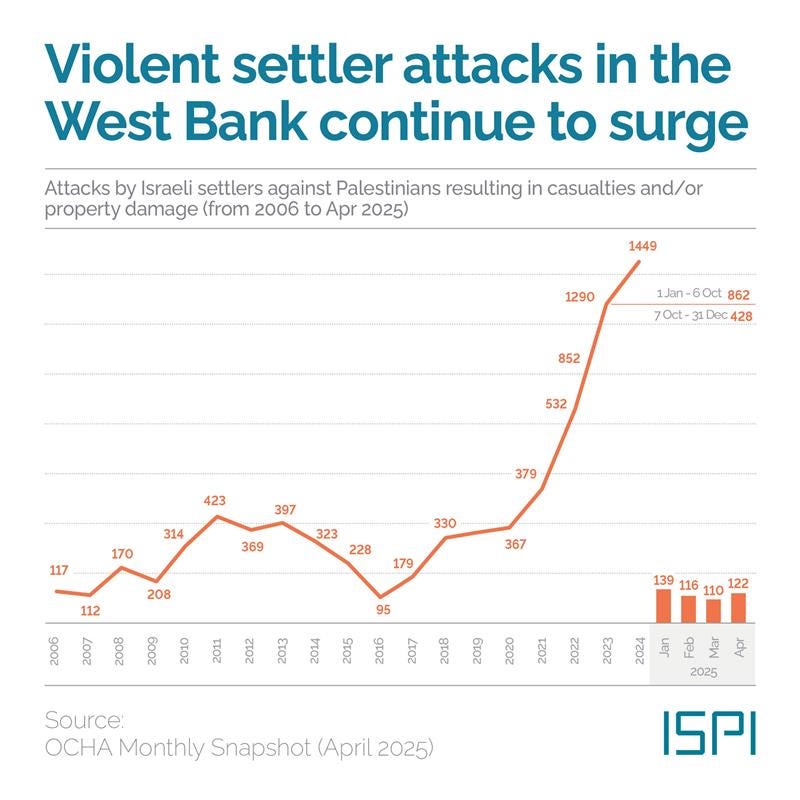
The far-right, pro-settler organization Regavim—one of whose founders is Finance Minister Bezalel Smotrich, himself a settler and the force behind the surge of housing units and settlement construction—insists that settler violence has been vastly exaggerated in UN accounts and that Palestinians are responsible for the vast majority of the occurrences. These claims fly in the face of the accumulated evidence—a great deal of it documented by the Israeli press and Israeli human rights groups, such as B’Tselem, Yesh Din, and Breaking the Silence. They are also suspect given the extent of control the Israeli military exercises over day-to-day Palestinian life in the West Bank. Besides, even if one accepts on faith Regavim’s claims that Palestinians perpetrated the bulk of West Bank violence, it avoids two key questions: First, on what legal basis are settlers in the occupied West Bank at all? Second, is resistance to outsiders’ land grabs, theft, and vandalism—which Regavim’s count does not include—normatively and legally equivalent to those acts themselves?
If one part of life for West Bank Palestinians is violence and harassment at the hands of settlers, another is the colonization of their homeland as manifested in the increases in the number of settlers and the growth of settlements, outposts, and housing units. The West Bank’s settler population (excluding East Jerusalem) has grown from 261,600 in 2006 to 503,732 in 2024, a 93% increase, with the figure exceeding 700,000 if East Jerusalem is included. The first Israeli West Bank settlement, Kfar Etzion, was reestablished in September 1967 (having been destroyed in 1948 after being first created in 1927). By 2026 there were 230 settlements excluding East Jerusalem, of which 54 were approved in 2025, the highest number in a single year. Illegal outposts were established starting in the early 1990s, and as of 2026 there were more than 300, 86 of which were created in 2025 alone. As for housing units, in 2025 alone, the Israeli authorities advanced 63,311 through the planning stage in East Jerusalem and the West Bank, an all-time record, though none of these units has yet been built.
The planning and approval of settlements and housing units has surged under Smotrich. In June of this year, the government allocated $431 million for 34 settlements, which had been approved in late 2022. In Smotrich’s mind, settlement-building is part of a larger strategy: making a Palestinian state impossible. Last September, he announced a plan to annex 82% of the West Bank. Israel has full control over Area C, which comprises 60% of the West Bank. The Palestinian Authority (PA) runs Area A, 18%, and shares jurisdiction over Area B, about 22%.(See map below.) The E1 settlement project (shown below, following the West Bank map), promoted by Smotrich and since then advanced by the Israeli planning authorities, would extend the existing Ma’ale Adumim settlement westward and add 3,401 housing units. The project would isolate East Jerusalem from the rest of the West Bank, bifurcate the territory, and make a contiguous Palestinian state—and hence a two-state solution—even less feasible. Announcing his approval in August 2025 while standing at the site, Smotrich called it the “final nail in the coffin” for the concept of a Palestinian state: what the world would see, he said, was not documents or declarations but homes, roads, and Jewish families. “This reality buries the idea for good—there is nothing to recognize.”
West Bank’s Three Areas
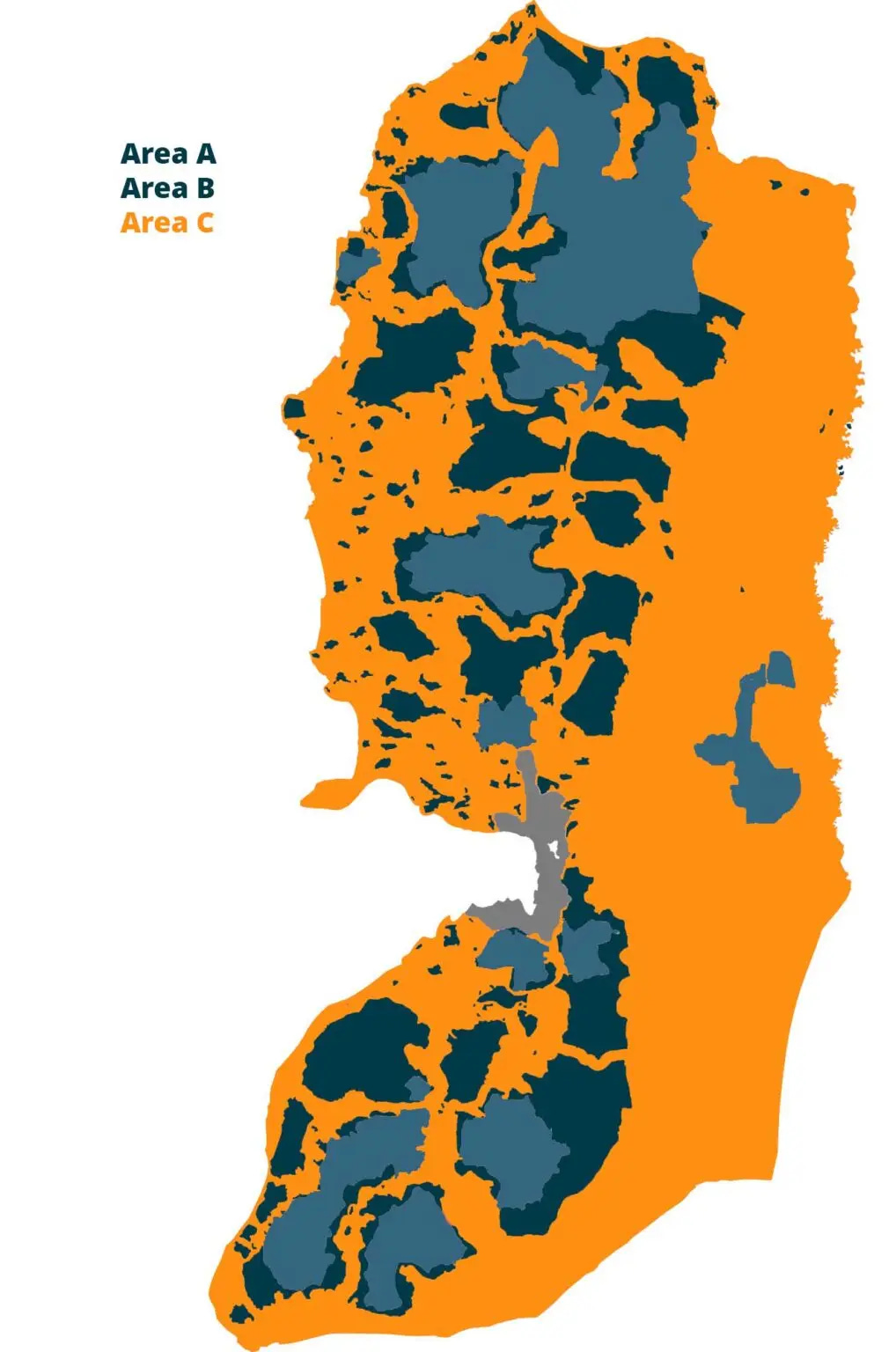
Source: Anera
The E1 Settlement Project
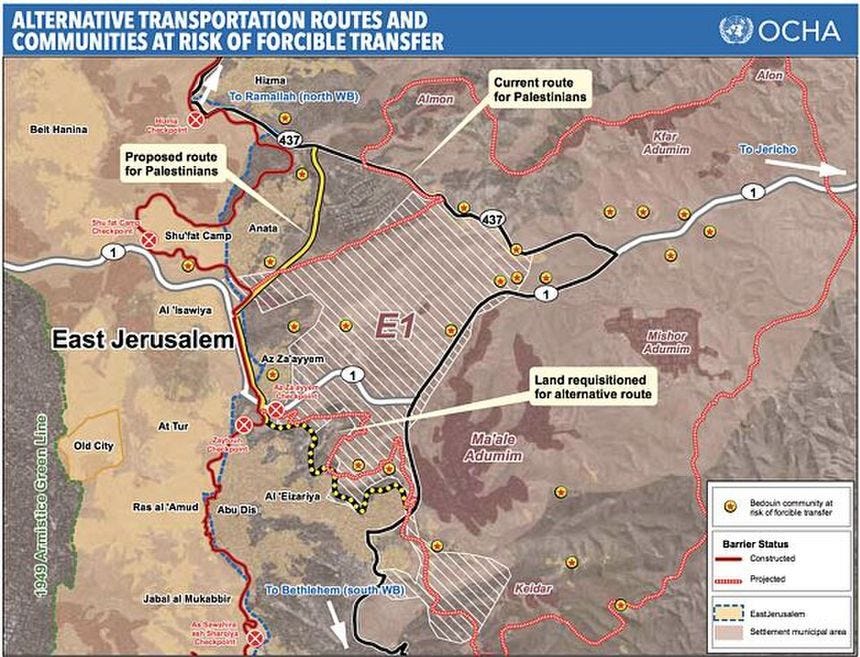
Source: Wikipedia
These and other steps aimed at appropriating West Bank land and building settlements are, as Smotrich has said more than once and reiterated this April, designed to “completely destroy the idea of a Palestinian state within our heartland,” and as he put iton a separate occasion, “The Palestinian state is being erased from the table not by slogans but by deeds. Every settlement, every neighborhood, every housing unit is another nail in the coffin of this dangerous idea.” He has justified his goal by pointing to Hamas’s October 7 attack. But this defense omits some important and inconvenient details: In 1988, the Palestine Liberation Organization, then led by Yasser Arafat, recognized Israel’s right to exist in peace, renounced terrorism, and pledged to end all violence. In 1993, it did so again, and committed to seeking, through diplomacy, a two-state solution. If there is terrorism occurring in the West Bank, the source is overwhelmingly settlers running amok, ignored and sometimes aided by the Israeli state. As the graph above shows, their attacks on Palestinians have grown steadily more frequent during the past decade—well before Hamas’s October 7 attack.
In return for abandoning armed struggle, the PA—the governance structure that emerged from the 1990s Oslo process—gained the right to run a small crazy quilt of small non-contiguous territories. It soon became apparent that nothing resembling a sovereign state across the West Bank would emerge. No such offer was made at Camp David in 2000 or Taba the following year. And under the right-wing prime ministers who governed for most of the years since—Ariel Sharon (2001–2006), Naftali Bennett (2021–2022), and Benjamin Netanyahu (1996–1999, 2009–2021, 2022–present)—the two-state solution withered on the vine. In consequence, the PA has discredited itself among many Palestinians by morphing into a collaborator that failed to deliver the two-state solution of a Palestinian state living side-by-side with Israel and exercising full sovereignty. Hamas emerged victorious in the January 2006 Palestinian elections for many reasons, but the Palestinians’ loss of faith in the PA was one of them.
If Israel’s post-October 7, 2023, war in Gaza has been widely denounced as a genocide, the proliferation of settlements in the West Bank, settlers’ attacks on Palestinians, and rules that create one form of daily life for Jews and a completely different one (full of restrictions and discrimination) for Palestinians, has led many scholars and human rights groups to describe Israel’s occupation of the West Bank as an instance of apartheid. As with the genocide charge, this judgment has been countered by defenders of Israel with accusations of antisemitism. Yet the conclusion that apartheid prevails in the West Bank has been reached by numerous Israeli scholars and public figures (who were among the signatories of a 2023 open letter), by the Israeli human rights organization B’Tselem, and by a group of 17 Israeli human rights organizations. Moreover, a 58-page Yesh Din report by the organization’s legal counsel Michael Sfard makes the conclusion credible.
A Political Settlement or Endless Violence
By almost any measure—deaths, injuries, expulsions, land seizures, restrictions on movement, humanitarian catastrophe—the Palestinians have gotten much the worst of it. This is not to make light of, let alone excuse, Palestinian violence against Israeli civilians. Yet as Israel’s actions in Gaza and the West Bank demonstrate, its preponderance of power has encouraged some of its worst instincts, which many Jews in Israel and the United States regard as incompatible with Judaism’s ethical principles. Israel, a state created as a safe haven for Jews following the Shoah, now itself stands accused of genocide. The response of Israel’s leaders and its most ardent Western supporters has been to denounce this as a blood libel. But the scale of the killing in Gaza and the plight of Palestinians following the ceasefire have led important Jewish scholars, Israelis included, such as Omer Bartov, Raz Segal, Amos Goldberg, and Shmuel Lederman to concur—reluctantly and after much thought—that what’s happened in Gaza qualifies as a genocide.
The Gaza war has also created a deep division within the American Jewish community, partly—but not solely—along generational lines. Those in the younger generation have been far more critical of Israel as well as more active in campus protests sparked by the war in Gaza. Israel is isolated internationally as never before. Antisemitism is a scourge that—like all ethnoreligious hatred—must be resisted without letup, especially because it is unquestionably on the rise. But to attribute criticism of Israel solely to antisemitism amounts to evasion, especially considering that an October 2025 Washington Post pollfound that 61% of American Jews believe that Israel has committed war crimes in Gaza and nearly 40% opine that it is guilty of genocide.
Israel will always have the upper hand in raw power over Palestinians, but fantasies of Israeli hardliners about mass expulsions to avert a Palestinian state are just that. The same goes for visions of a Jewish state extending from the Jordan River to the Mediterranean Sea—a formulation that has become a lightning rod in the United States because it is also used in support of Palestinian statehood. The slogan appears, for example, in Article 20 of Hamas’s 2017 Document of General Principles and Policies, and H. Res. 883, which passed the House on April 16, 2024 by 377–44, denounces it as antisemitic, as have many supporters of Israel.
Yet the same formula appears in the Likud Party’s 1977 founding platform, which asserts that “between the Sea and the Jordan there will only be Israeli sovereignty.” It has also been invoked by Netanyahu and Smotrich and framed in a different way in National Security Minister Itamar Ben-Gvir’s call for the annexation of the West Bank and “the complete dismantling of the Palestinian Authority.”
The biggest problem facing a Jewish state determined to negate Palestinian self-determination is that the Palestinian people aren’t about to go away, and that a mass expulsion, quite apart from being infeasible, would increase Israel’s already-acute isolation. Ramped-up settlement-building and land appropriation in the West Bank, together with what appears to be creeping de facto annexation in Gaza, are making a two-state solution impossible, which, in any event only 27% of Israelis supported in a 2025 Gallup poll—a big shift: 61% favored it in 2012. (There has been a comparable decline in Palestinian support for a two-state solution.) But there is even less support—1% in a 2025 survey—among Israeli Jews for a single state in which Jews and Palestinians enjoy equal rights. What’s left is a cycle of occupation and repression that will be met with resistance, including violence, with no guarantee that Israel’s superior power will prevail indefinitely, especially as it loses one of its biggest advantages: unquestioning American support.
France held Algeria for 132 years, deploying half a million troops at the high point. But it left in 1962. Britain ruled Ireland for centuries yet failed to hold the twenty-six counties, which, after a period of self-governance within the British Commonwealth starting in 1922, became a fully independent country in 1949. Apartheid South Africa possessed far more power than the African National Congress, and the system of white supremacy lasted for nearly half a century. But it could not be preserved and ended following negotiations culminating in the 1994 multiracial elections. The white settlers did not leave; what changed was the system, which thereafter rested on legal equality between them and the non-white majority.
These are only a few cases, and the pattern is certainly not universal. But the record offers little support for the conviction that a national movement can be extinguished by force alone, or that an occupation can deliver lasting security to the occupier. Israel may believe its preponderant power makes it an exception, but the history of occupations during the last 200 years suggests otherwise. Absent a political settlement that reconciles Israel’s security with Palestinian self-determination, the violence will continue.