Straitjacketed
Donald Trump is now in a bind of his own making.
[2,199 words—a 9-minute read.]
Imagine that Natalie Harp, President Trump’s thirty-four-year-old Executive Assistant, who reportedly rarely leaves his side and helps craft his posts on Truth Social, were asked by her boss to write a message summing up for Americans where things stand with Iran. It would be faithful to Trump’s trademark style, of course, and read something like this:
At MY direction, the American armed forces, the GREATEST military force in HUMAN HISTORY, have launched HUNDREDS of strikes at IRAN to punish it for attacking ships in violation of the June 17 Memorandum of Understanding (MOU), which I agreed to sign ONLY because Iran’s leaders had been BEGGING for a deal, following the DEMOLITION of their missiles, Navy, and Air Force. They hold NO CARDS and must stop all attacks on ships in the Strait of Hormuz and on our Persian Gulf allies and pledge never to have nuclear weapons—or face the destruction of their CIVILIZATION.
Thank you for your attention to this matter. President Donald J. Trump.
Some Background to Assess Trump’s Claims
The MOU was supposed to rescue a ceasefire that had held, precariously, since April but was fraying badly by early June, when the two sides signed a new 60-day framework.
In the MOU’s first stage, Iran was to allow commercial shipping to move freely through the Strait of Hormuz. That mattered enormously to Trump, who was desperate to stop further price increases, especially at gas stations. Recall that Iran had shut down the Strait after the United States and Israel attacked it on February 28, disrupting the flow of oil, gas, diesel, fertilizer precursors, helium, and other essential commodities. Prices rose, fears of a global recession mounted, and Americans’ support for the war plummeted—all as the November midterm elections approached.
In return for Iran’s unblocking of the Strait, Washington agreed to lift its naval blockade of Iranian ports, end restrictions on Iran’s oil exports by issuing a waiver, begin removing economic sanctions on Iran, and gradually release its frozen assets. These economic concessions were central to Tehran’s objectives because sanctions have choked its economy, with occasional relief, for nearly 50 years.
In the second stage, the MOU provided for negotiations over Iran’s nuclear program. Washington wanted Iran to stop enriching uranium and sought to remove Iran’s stockpile of 60-percent-enriched uranium from the country or, failing that, to dilute it—under IAEA supervision—to levels unsuitable for making bombs. This was critical for Trump, who has vowed, time and again, that “Iran will never have a nuclear weapon.”
If both sides fulfilled their obligations, the temporary ceasefire was supposed to become a lasting peace.
That is not what’s happened.
The ceasefire that preceded the MOU had been fragile from the start, punctuated by a dual U.S.-Iran blockade and repeated Strait closures. It was fraying further by early June, when Iran fired missiles directly at Israel for the first time since the truce took hold in April — retaliation for an Israeli strike on Beirut amid the unresolved fighting in Lebanon. That exchange nearly collapsed the process before the June 17 MOU could be signed.
The MOU bought only a brief pause. Beginning June 25, Iran resumed attacking commercial shipping in the Strait — first the container ship Ever Lovely, then, two days later, the tanker Kiku. The United States retaliated by striking Iranian coastal radar, missile, and drone facilities. Iran responded on June 28 by hitting American bases in Bahrain and Kuwait. A second pause also failed to hold: by early July, Iran was again attacking ships. Trump then ordered successive waves of strikes on hundreds of Iranian targets, and Iran launched missiles and drones at American bases in Bahrain, Kuwait, Qatar, and Jordan, starting on July 7. On July 11, Tehran again closed the Strait.
In other words, the United States and Iran are now close to where they were before the June agreement: they have resumed their attacks, the Strait is closed, commercial shipping is at risk, and each side is testing the other’s ability and willingness to withstand the military, economic, and political strain.
Trump’s Claims vs Reality
Trump’s strategy can be judged against four objectives: reopening the Strait, ending attacks on shipping and American forces, compelling Iranian acceptance of American nuclear terms, and producing a permanent ceasefire. It has failed on every count.
· The very idea that there has been anything that can be called a ceasefire is a fiction. Iran and the United States continue trading attacks, and Tehran continues to target shipping in the Strait.
· The MOU’s provisions concerning Lebanon haven’t been implemented. Trump seems to have assumed, wrongly, that Iran would trade them away. Israel remains in occupied territory south of the Litani River, Hezbollah remains armed, and there is no credible prospect that the Lebanese Army can forcibly disarm it. Tehran sees the continued fighting in Lebanon as evidence that Washington either cannot or will not deliver on commitments made under the agreement and is determined to continue backing its most important regional ally.
· There’s no evidence that Iran has been “begging for a deal” or that its military capabilities have been eviscerated, as Trump claims. If his claim is accurate, why would CENTCOM keep declaring that it has been acting in self-defense? Iran regards its ability to attack U.S. bases in the Persian Gulf as one of the principal “cards” it holds, and its continued attacks demonstrate that it retains significant military capabilities.
· Iran has ignored Trump’s ultimatum to reopen the Strait, and his reimposition of the ban on Iranian oil exports has not changed its calculus. Iran doubtless has serious economic problems—inflation is sky-high (more than 80%), the Rial is trading at 1.4 million to the dollar, businesses have been closing, and youth unemployment exceeds 20%. Yet the fear of domestic unrest hasn’t rattled its leadership into accepting Trump’s demands. That’s what matters: Trump’s economic coercion is meant to induce Iran to rethink its positions. So far, it has not.
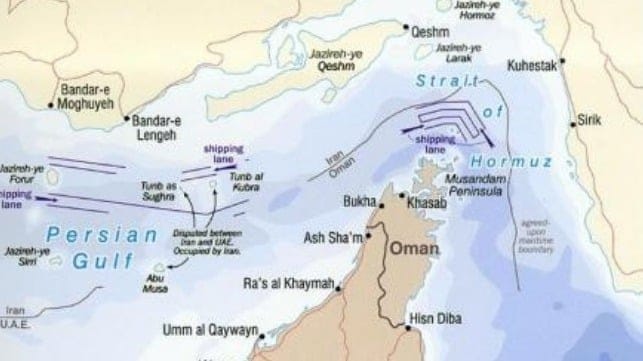
· Iran is determined not to return to the prewar status quo, when the Strait was open to all shipping at no cost. It wants to impose a fee for unspecified maritime “services,” preferably through a joint arrangement with Oman, which sits on the opposite side of the Strait. It sees Point 5 of the MOU—”The Islamic Republic of Iran will conduct dialogue with the Sultanate of Oman, to define the future administration and maritime services in the Strait of Hormuz, in discussions with other Persian Gulf Littoral States, in line with applicable international law and the sovereign rights of coastal states of the Strait of Hormuz”—as giving it that right. Its most recent closure of the Strait followed a breakdown in talks with Oman on a joint arrangement. Iran insists that ships will be safe only if they pass through the northern channel off its coast. Shipping through the Strait remains at a trickle compared to the prewar volume.
Source: The Maritime Executive
· Things are now essentially back to where they were during the February 28–April 8 war. Yet another source of instability remains. Netanyahu has never reconciled himself to the MOU and continues to believe that resuming the war will produce “regime change” in Tehran. If he concludes that the agreement is effectively dead, he could seize on the latest escalation to resume attacks on Iran—and Trump may find difficult to avoid backing Israel.
No Good Options for Trump
Trump can opt to return to war, but he can’t assume that the results will be any different than they were between February 28 and April 8. Iran not only weathered the joint attacks of Israel and the U.S. back then, it also used cheap drones to force the U.S. to fire expensive interceptor missiles, draining American stocks; did considerable damage to Israel, proving that it could penetrate Israel’s much-vaunted air defenses; and repeatedly attacked Washington’s Persian Gulf allies. Far from “begging” for talks and a deal, Iran forced Trump to end the war. It also contributed to a rift between Washington and Israel, which wanted the fighting to continue. Netanyahu angered Trump by declaring that Israel was not bound by the MOU’s provision for a ceasefire in Lebanon, let alone Tehran’s demand for a complete Israeli withdrawal.
Yes, Iran was hit hard between February 28 and April 8, but the point is that it didn’t cave—and likely won’t. The purpose of war isn’t to pummel an adversary as an end in itself, but to use force to compel it to surrender outright or accept unpalatable terms. This point seems to elude those who harp on the military balance between Iran and the U.S., which overwhelmingly favors Washington. Yet a massive advantage in firepower hasn’t helped Russia subdue Ukraine in a war that has lasted more than four years. Nor did it produce an American victory against the Taliban in Afghanistan.
Trump can reimpose the naval blockade to supplement the renewed ban on Iranian oil exports. But Tehran understands that economic stress cuts both ways. It believes Trump survived the June 7 flare-up without letting the ceasefire collapse, and later signed the June 17 MOU, because the war was taking a toll on the U.S. economy and beginning to alienate parts of his political base, notably in rural areas, where farmers faced fertilizer shortages. Iran assumes that the pressure on Trump will mount as the clock keeps ticking and the November midterms approach. And it sees its ability to close the Strait as its trump card.
Trump could try to open the Strait by force and order the Navy to escort ships through the Omani channel — a threat he’s underscored by sending two nuclear-powered aircraft carriers into the region. But Iran would then unnerve insurance companies and the owners of tankers by declaring that ships would be using that route at their own risk. Tehran has already sent that message by firing at defiant ships, forcing some to turn back. To open the Strait completely, the United States would have to remove the mines Iran laid during the war—in the northern route as well as in the two-nautical-mile-wide buffer zone separating from the southern route. That protracted mission would have to be conducted while shore-based Iranian drones and missiles threaten American naval forces. The Navy would face the same risk if it were ordered to escort tankers through the Strait.
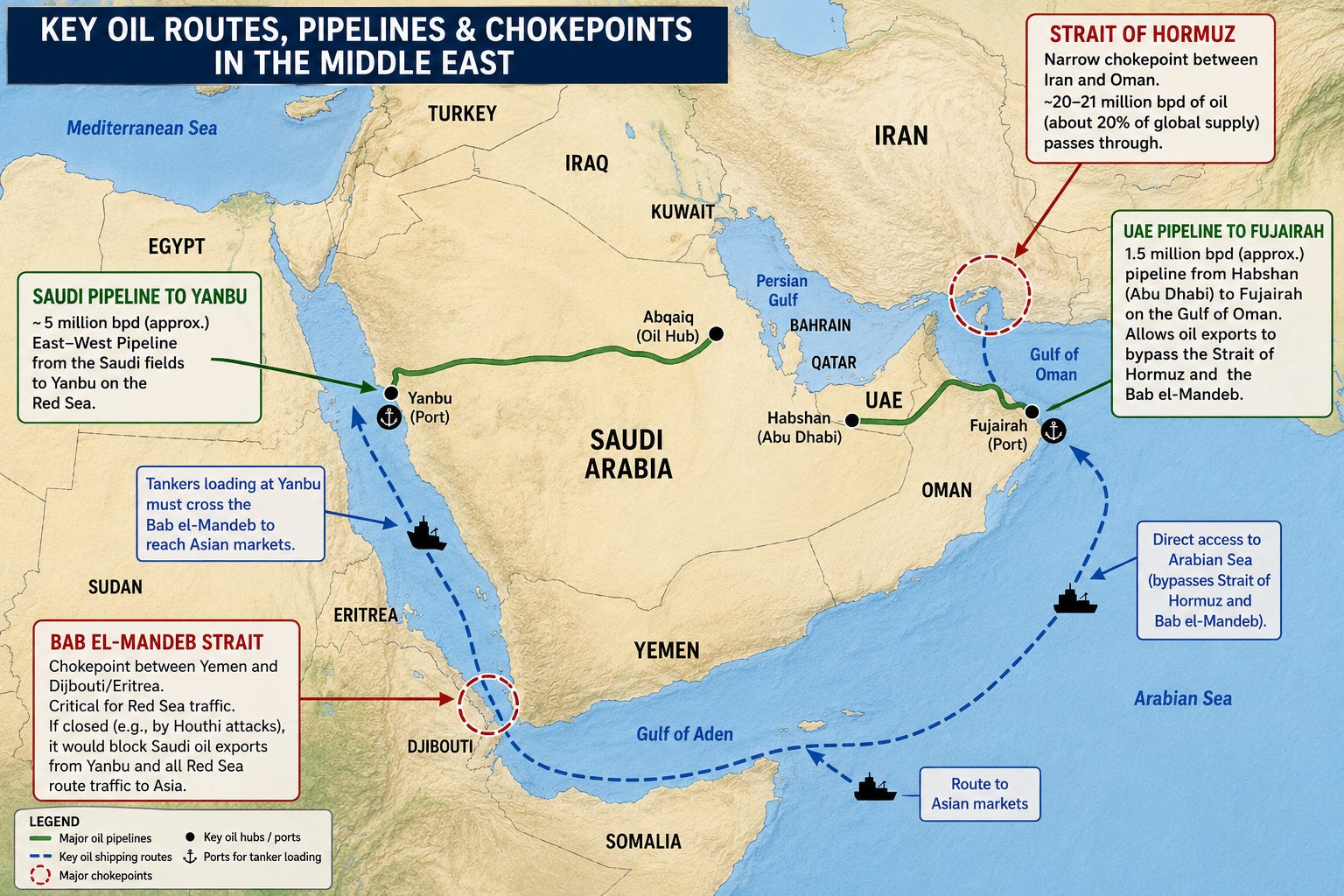
If Trump does up the ante by intensifying strikes on Iran and trying to force the Strait open, Iran could respond by shutting down the Bab-el Mandeb Strait—in coordination with its Yemeni ally, Ansar Allah (commonly referred to as the Houthis). That would block Saudi oil exports that rely on the pipeline to Yanbu on the Red Sea — tankers loading there still have to cross the Bab-el-Mandeb to reach Asian markets, so a Houthi closure would cut off that route too. The UAE, by contrast, is better situated: its pipeline to Fujairah on the Gulf of Oman lets tankers load with direct access to the Arabian Sea, bypassing both the Strait of Hormuz and the Bab-el-Mandeb. Yet Fujairah itself isn’t beyond Iran’s reach, as the March strikes on the port showed.
Source: Generated using AI.
Trump can continue to make scary threats to pressure Iran, but they haven’t worked so far. The stakes in the war are far higher for Iran, and it is determined not to yield. Moreover, Iran’s leaders have no trust in the U.S., and Trump in particular. They believe that Washington will welch on commitments, reimpose the restrictions on Iran’s oil exports, and renege on promises to unfreeze its assets. The more Trump threatens Iran but fails to follow through for fear of a prolonged war and worsening economic fallout, the more Tehran will conclude that it holds the stronger hand and that time favors it.
In short: Iran is under pressure, but what matters is whether it believes that Trump is under even greater pressure. It does—and so far, its wager has been vindicated.
Did Trump Have Better Options?
Trump had another, better path available. He could have tried to build on the JCPOA rather than abandoning it, working with Congress to remove sanctions legislation provided Iran agreed to make the deal’s strict limits on uranium enrichment and its verification requirements permanent. That would have kept in place a framework that, whatever its critics said, had demonstrated it could constrain Iran’s nuclear program without war.
He could also have avoided joining Israel’s February 28 attack, which led Iran to close the Strait of Hormuz and disrupt global commerce. Staying out would not have guaranteed a different outcome — Israel might well have struck regardless — but it would have preserved Washington’s standing as a mediator rather than a combatant, and left Trump more room to negotiate from outside the war rather than clean up after it.
He chose neither course. Instead, he opted for a strategy of intimidation and coercion, assuming that Tehran would fold. It has not. Iran continues to resist his demands, to threaten shipping, to strike American allies and bases in the Persian Gulf, and to impose steep costs on the U.S. and global economy. Trump now finds himself in a predicament largely of his own making.
Thank you Rajan. Trust has to be earned. I don't know if we have negotiators who are skilled enough in this administration especially as trump himself, sonstantly tweeting has sabotaged any attempt for reconciliation between the US and Iran. Yes, it is a bind of his own making..